So, you want to leash train your dog
—but, you don’t know what you’ll need or how to do it?
Here is a starter list of tips and materials to set yourself and your dog on the road to success so you can BOTH enjoy your walks!
Looking for someone to walk your dog while you’re away or at work? Schedule a trusted dog walker with Perna’s Pet Care now: Click here!

Harness and Leash:
First and foremost, you will need some gear to help keep your dog safe while you leash train:
- It is recommended that you use a well-fitting harness that does not restrict movement in the shoulders, including a chest clip
- You can locate your dog’s shoulders by either watching them walk, or if they are comfortable with it, using your hands to find where it starts and ends. This is where the back of the harness should fit.
- Use a leash with enough space for you to keep your hands at your side without pulling on the dogs harness (depends on your height compared to your dog), usually 6ft is good. We do NOT recommend a retractable leash.
Check out a favorite harness of Perna’s Pet Care: 2 Hounds Design
NOTE: Using a harness and chest clip is not a foolproof or instant fix for things like pulling or reactivity, despite what some sources or marketing schemes may make you think. However, with the proper training used in tandem with this gear, you and your dog can work together to associate the sensation of a taut leash disrupting momentum in their chest and shoulders to mean your dog needs to turn around and come back to you.
Loose Leash Walking:
Reward your dog for walking with a loose leash with Treats, Toys, and Play.
When your dog does pull, creating a taut leash with no slack, your best course of action is to: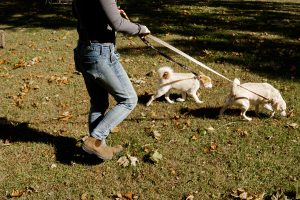
1. Plant your feet in a such a way that prevents your dog from reaching the thing they are pulling towards. You can also try to move the leash across your back or walk with it in this position already for extra support, especially if your dog is particularly large or strong.
–>The objective here is to not allow your dog to reach what they want, because they will associate the act of pulling and the sensation of a taut leash with being rewarded.
2. Attempt to get your dog’s attention by softly and kindly calling their name, making kissing noises, hitting your thighs, or even jumping up and down enthusiastically.
If your dog is particularly fixated, you can use a reward object such as a treat or toy held tightly in your hand and hold it close to their nose, then bring it towards yourself while taking steps backwards (if you use this method, do not allow your dog to have the reward object until they have performed the desired action and you have given a marker word).
–>The objective is to be more exciting than whatever it is they are pulling towards.
When your dog has turned their attention away from whatever they were pulling towards and given it to you, and the leash is no longer taut, you may give a marker word closely followed by something rewarding to them, such as a treat or a stick.
NOTE: A marker word can be any sound or word of your choosing, so long as you are consistent with it, and it is always followed by a reward—even if the marker was given accidentally! Common marker words are yes, yis, yip, a clicker, or my personal favorite, “thank you”!
 3. If it is safe for them to do so, you can now allow your dog to engage with what they were pulling towards!
« What not to do: Avoid pulling back on the leash, as this can lead to a desensitization of the feeling, or your dog can interpret it as a game.
Avoid also using words like “no,” or anything with intent to startle or intimidate your dog, as this does not create a productive learning environment and can lead to overstimulation, shut down, and even depression.
Treats, Toys, and Play:
When you leash train, it should be fun for you and your dog! You want them to enjoy how they feel when they are training, so they associate what they are learning with good feelings. This will make your dog more willing to perform how you have shown them you prefer them to!
This means you need to find out what exactly is rewarding to your dog. Most dogs are happy with treats, which is what many people call being “food motivated.”
However, this is not always the case!
If your dog prefers a particular toy, make sure you bring it along with you while training to use it as a reward. Allow them to engage with the toy on their own or, if they prefer, play with it with them.
If your dog is not interested in either one, you may allow them some freedom to sniff or could even provide them with a scented object such as an old hat or a sock.
Treat Pouch or Fanny Pack:
If you will be out leash training with your dog, you probably want something to carry all your tools in. Something you can easily access such as a cross-body or fanny pack, or a treat pouch fastened to your hip, can be a game changer when it comes down to those critical seconds when your dog has just performed a desired behavior and it is time to reward them.
Remember, a dog’s working memory has a lower threshold than human’s, so it is imperative that your marker word and subsequent reward are within a matter of seconds after your dog performs a desired behavior.
Have A Positive Attitude!
Before you suit up yourself and your dog for a leash train session, take a moment to check in with yourself.
- Are you tired?
- Are you emotionally strained?
- Are you feeling distracted?
- Are you feeling social?
If you do not feel you are in a good headspace to provide a patient teaching environment, consider skipping leash training for the day and substituting it with something like active play or enrichment games instead. Not every day has to be a training day!
Check out this video to see VSA certified dog trainer Clinton training loose leash!
Interested in starting 1-on-1 training sessions? Reach out HERE to schedule your free intake phone call and learn more about how we can help!